In wastewater treatment, the toughest challenges rarely come from volume alone.
They come from concentration.
Higher solids loading.
Heavier organic content.
Tighter discharge norms.
Shrinking plant footprints.
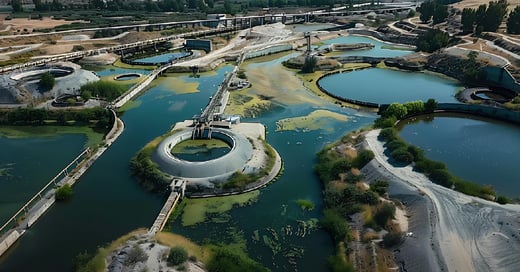
Across industrial zones, urban infrastructure, and fast-growing economies, wastewater systems are being pushed far beyond the conditions they were originally designed for. What once worked with generous space, predictable influent, and lenient regulations is now struggling to cope with high-solids wastewater in constrained environments.
This is no longer an operational inconvenience.
It is a structural problem.
And for many plants, it has become the single biggest barrier to compliance, reuse, and future growth.
The Global Bottleneck: High Solids, Limited Space, Rising Pressure
Worldwide, wastewater generation is increasing faster than treatment capacity—especially in industrial and peri-urban regions. According to global water agencies, more than 50% of industrial wastewater still enters treatment systems with solids loads that exceed original design assumptions.
At the same time:
- Land availability around plants is shrinking
- Retrofit opportunities are limited
- Capital expenditure is under scrutiny
- Downtime is unacceptable
This creates a dilemma operators everywhere recognise:
How do you treat more solids, in less space, without sacrificing efficiency or compliance?
Traditional clarifiers and reactors were never built for this reality.
Why Conventional Systems Are Reaching Their Limits?
Conventional wastewater treatment infrastructure depends heavily on footprint. Larger basins, longer retention times, and multiple stages were historically used to manage solids and load variations.
Today, this approach breaks down because:
- An expanding footprint is often impossible
- High solids reduce settling efficiency
- Hydraulic overloading causes short-circuiting
- Sludge handling becomes unstable
- Performance becomes inconsistent under fluctuating loads
The result is predictable:
- Frequent operational intervention
- Increased chemical and energy consumption
- Sludge carryover and compliance risk
- Escalating lifecycle costs
What plants need is not more equipment, but smarter hydraulics and process intensity.
Why Compact, High-Throughput Treatment Is the Only Way Forward?
Modern wastewater challenges demand a fundamental shift in design philosophy.
Instead of spreading treatment across large civil structures, next-generation systems focus on:
- Higher treatment intensity per unit area
- Stable performance at elevated solids concentrations
- Shorter retention times without performance loss
- Predictable operation under variable loading
This is where compact, high-throughput clarifiers and reactors change the equation.
They don’t just save space.
They redefine what is possible within that space.
Rethinking Clarification and Reaction
At the heart of efficient wastewater treatment lie two critical functions:
- Solid–liquid separation
- Controlled biological or chemical reaction
When either becomes unstable, everything downstream suffers.
Compact clarifiers and reactors are engineered to:
- Handle high influent solids without performance collapse
- Maintain consistent hydraulic behaviour
- Improve settling and separation kinetics
- Support higher organic and hydraulic loads
This allows treatment plants to process more wastewater—without increasing footprint.
Ion Exchange’s Approach: Engineering for Constraint, Not Comfort
For decades, Ion Exchange has worked across regions where space, water stress, and regulatory pressure are a daily reality—not an exception.
That experience has shaped a clear design principle:
Systems must perform at their limits, not just at ideal conditions.
Ion Exchange’s compact, high-throughput clarifiers and reactors are built specifically for:
- High solids wastewater
- Space-constrained installations
- Retrofit and brownfield projects
- Facilities where downtime and instability are not acceptable
Rather than scaling up in size, these systems scale efficiency.
What Makes These Systems Different in Practice?
These solutions are not miniaturised versions of conventional tanks. They are re-engineered systems designed to extract more performance from every square metre.
On the ground, this translates into:
-
Higher Solids Handling Capability
Optimised hydraulics and internal flow control enable stable operation even under elevated suspended solids and organic loads.
-
Smaller Footprint, Same—or Better—Performance
Treatment capacity that would normally require large basins can be achieved in a fraction of the space.
Improved contact, separation, and reaction efficiency reduces retention time without compromising effluent quality.
Plants experience fewer upsets, more predictable sludge behaviour, and reduced operator intervention.
Compact systems reduce civil costs, energy consumption, and long-term maintenance burdens.
This is not just space-saving.
It is performance compression.
Why This Matters for the Next Decade of Infrastructure?
Globally, infrastructure planning is changing.
Industries are expanding within existing boundaries.
Cities are densifying, not spreading.
Environmental norms are tightening, not relaxing.
In this context, wastewater treatment solutions must:
- Fit into constrained sites
- Handle future load growth
- Support reuse and circular water strategies
- Remain compliant under variable conditions
Systems that rely on large footprints and marginal performance buffers will not survive this transition.
Compact, high-throughput treatment is no longer an innovation.
It is an inevitability.
Where These Solutions Deliver Maximum Impact?
Ion Exchange’s compact clarifiers and reactors are particularly suited for:
- Industrial wastewater treatment plants with high solids and limited expansion space
- Urban and peri-urban STPs under footprint pressure
- Industrial parks and estates requiring decentralised, efficient treatment
- Retrofit projects where existing systems are underperforming
- Facilities targeting water reuse, where consistent upstream performance is critical
In each case, the objective is the same: treat more, in less space, with greater reliability.
From Compliance Tool to Strategic Asset
For too long, wastewater treatment has been treated as a regulatory necessity—something to be hidden, minimised, and delayed.
That mindset is changing.
Efficient wastewater treatment today directly affects:
- Water security
- Operational continuity
- ESG performance
- Long-term cost control
- Expansion readiness
Compact, high-throughput systems allow wastewater infrastructure to evolve from a constraint into a strategic utility—one that supports growth instead of limiting it.
Final Thought: The Future Belongs to Systems Built for Pressure
Wastewater treatment is entering an era defined by constraints—of space, resources, and tolerance for inefficiency.
The systems that will endure are not the biggest.
They are the smartest.
By enabling high-solids treatment in compact footprints, Ion Exchange is helping industries, cities, and infrastructure projects move toward wastewater systems that are faster, more efficient, and ready for what comes next.
Because in the future of wastewater treatment, efficiency is not a feature.
It is the foundation.
Connect with our experts to explore how compact, high-throughput clarifiers and reactors can future-proof your wastewater infrastructure.