In industrial operations, downtime rarely announces itself in advance.
It appears quietly—during regeneration cycles, pressure drops, inconsistent water quality, or delayed recovery after maintenance. Over time, these interruptions compound, affecting production schedules, energy efficiency, and operating costs.
For global manufacturers running continuous or near-continuous operations, the question is no longer whether water softening is required but whether traditional softening systems are keeping pace with modern performance demands.
The Hidden Cost of Regeneration Downtime
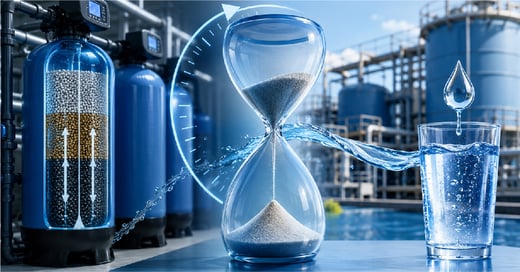
Water softeners play a critical role in protecting boilers, cooling systems, and process equipment. But conventional softening systems often introduce an overlooked challenge: regeneration downtime.
During regeneration:
- The treated water supply is interrupted
- Systems rely on standby capacity or storage
- Operations face pressure fluctuations or delays
Across industries, even short interruptions can translate into:
- Reduced throughput
- Higher energy consumption
- Increased operational complexity
In high-utilization plants, downtime is not just an inconvenience—it is a measurable cost.
Why Traditional Softening Systems Are Being Re-evaluated?
Many conventional water softeners were designed for environments where:
- Demand was predictable
- Regeneration windows were flexible
- Sustainability targets were secondary
Today’s industrial landscape looks very different.
Global facilities are now dealing with:
- Higher water demand density
- Tighter production schedules
- Pressure to reduce water, salt, and energy usage
- Stronger focus on operational continuity
As a result, regeneration efficiency and system recovery time have become as important as hardness removal itself.
The Shift Toward Rapid-Regeneration Softening
Forward-looking facilities are adopting a new approach: rapid-regeneration water softening.
Rather than accepting long regeneration cycles, this approach focuses on:
- Faster regeneration without compromising performance
- Minimal disruption to treated water availability
- Reduced water and salt consumption
- Lower operational footprint
The objective is simple: maintain an uninterrupted supply while improving efficiency and sustainability.
Where INDION Swift Softener Fits In?
The INDION Swift Softener was developed to address precisely this challenge—helping facilities reduce downtime while sustaining performance.
By enabling rapid regeneration, the system supports:
- Continuous or near-continuous treated water availability
- Faster recovery after regeneration cycles
- Lower overall footprint in terms of water and resource usage
Instead of working around regeneration downtime, operations can maintain momentum.
What Rapid Regeneration Changes in Day-to-Day Operations?
For industrial teams, the impact of faster regeneration is practical and immediate:
- Less reliance on standby systems or storage
- More predictable water availability
- Improved operational confidence during peak demand
- Lower stress on downstream equipment
Over time, these gains contribute to improved asset protection, energy efficiency, and smoother plant operations.
Beyond Performance: Lower Footprint, Smarter Use of Resources
Efficiency today is not measured only by output but by how intelligently resources are used.
Rapid-regeneration softening supports:
- Reduced water wastage during regeneration
- Optimised salt usage
- Lower energy demand linked to interruptions and recovery
For facilities pursuing sustainability and cost optimization together, this becomes a strategic advantage—not just a technical upgrade.
Why Global Facilities Are Rethinking Softening Strategy?
Across regions, industrial operators are recognizing that:
- Downtime has a direct impact on profitability
- Water treatment must align with continuous operations
- Regeneration efficiency affects overall plant resilience
Water softening systems are no longer evaluated only on hardness removal but on how seamlessly they support operations at scale.
Designing for Continuity, Not Interruption
In modern industrial environments, performance is defined by consistency.
Systems that minimise interruption, recover faster, and use resources efficiently are better suited for long-term reliability. Rapid-regeneration softening is one such evolution—designed for plants that cannot afford to pause.
Conclusion
If regeneration downtime, operational interruptions, or resource efficiency are part of your current water softening challenge, our experts can help you evaluate whether rapid-regeneration systems are right for your operations.
Connect with our experts to explore smarter softening strategies for uninterrupted performance.