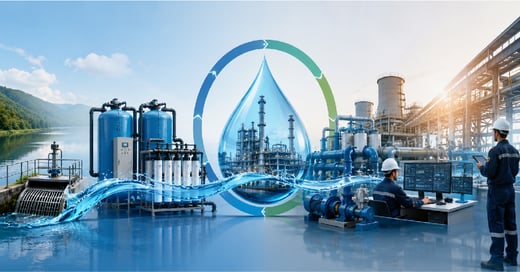
Cooling towers are among the most critical and most underestimated systems in industrial operations worldwide.
From refineries and power plants to chemical and manufacturing facilities, cooling towers quietly regulate temperatures, protect equipment, and sustain uptime. Yet when problems arise, they rarely announce themselves early.
They escalate.
Corrosion, fouling, microbiological growth, and scaling often remain invisible until efficiency drops, energy consumption rises, or unplanned shutdowns occur. By the time alarms are triggered, damage is already underway.
The real question global operators are now asking is not how to fix cooling tower failures, but:
Why are we still reacting to problems that can be predicted?
The Hidden Risk in Cooling Tower Operations Worldwide
Across regions, cooling towers are facing increasing stress due to:
- Variable make-up water quality
- Higher cycles of concentration
- Rising energy costs
- Stricter environmental and safety regulations
According to industry studies, cooling system inefficiencies can increase plant energy consumption by 10–20%, while corrosion and fouling significantly shorten asset life.
Yet most cooling tower programs still rely on periodic manual testing and reactive chemical dosing methods that struggle to keep up with dynamic operating conditions.
Why Traditional Monitoring Falls Short?
Cooling tower chemistry is not static. Load variations, weather changes, and water source fluctuations can alter system behaviour within hours.
Traditional approaches often suffer from:
- Delayed visibility into water chemistry changes
- Inconsistent dosing decisions
- Overuse or underuse of treatment chemicals
- Limited ability to predict risk trends
This reactive model leaves operators exposed to:
- Accelerated corrosion
- Heat transfer losses
- Increased water and chemical consumption
- Compliance and safety risks
Global facilities are increasingly realising that manual monitoring cannot deliver real-time protection.
The Shift Toward Predictive Cooling Water Management
Forward-looking plants are now adopting a different mindset:
from corrective action to predictive control.
Predictive cooling water management focuses on:
- Continuous monitoring of critical parameters
- Early identification of corrosion and fouling risk
- Automated, data-driven chemical control
- Reduced dependency on manual intervention
This approach allows operators to detect deviations before they escalate into failures, protecting both equipment and operating margins.
A Real-World Example: Predictive Risk Detection in Action
At a leading refinery, cooling tower operations faced persistent challenges:
- Inconsistent water quality
- Fluctuating corrosion risk
- Rising chemical consumption
- Limited real-time visibility
Rather than increasing chemical dosing or inspection frequency, the facility adopted a predictive monitoring and control approach using INDION® Autochem.
The objective was clear:
Detect cooling tower risks early—and act before performance or safety is compromised.
How INDION Autochem Changed the Outcome?
INDION® Autochem enabled:
- Continuous, real-time monitoring of key cooling water parameters
- Early identification of corrosion and scaling trends
- Automated chemical dosing adjustments
- Reduced manual dependency and response time
Instead of reacting to failures, operators gained advanced insight into system behaviour, allowing proactive intervention.
The result was not just improved control, but improved confidence in cooling tower performance.
What Sets Predictive Cooling Management Apart?
This case highlights a broader shift underway across global industries.
Predictive cooling water management delivers:
- Early risk detection, not delayed alarms
- Optimised chemical usage, not overcorrection
- Improved heat transfer efficiency
- Lower operating and maintenance costs
- Greater regulatory and safety assurance
For complex industrial operations, this approach transforms cooling towers from a vulnerability into a controlled asset.
The Bigger Picture: From Monitoring to Intelligence
As industrial systems grow more complex, visibility alone is no longer enough.
The future of water management lies in:
- Continuous data
- Predictive insights
- Automated response
- Risk-based decision-making
Cooling towers are no exception.
Facilities that invest in predictive intelligence today are better positioned to protect uptime, reduce resource consumption, and operate with long-term resilience.
Why Global Facilities Are Rethinking Cooling Water Strategy?
Across regions, operators are recognising that:
- Reactive monitoring increases cost and risk
- Predictive systems improve stability and efficiency
- Early detection is significantly cheaper than late correction
The question is no longer whether cooling tower risks can be detected early—but whether your current strategy allows it.
Conclusion
Cooling tower risks don’t need to be discovered after efficiency drops or failures occur.
If you’re exploring how predictive monitoring and intelligent water management can strengthen reliability, reduce risk, and improve operational control across your facilities, our experts are ready to help you evaluate the right approach.
Connect with our experts to explore smarter cooling water strategies.