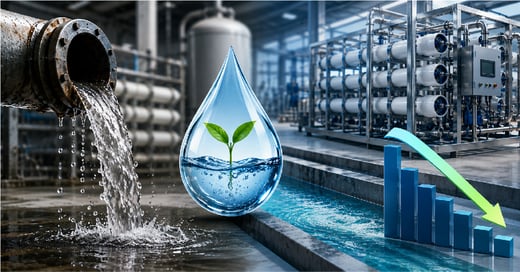
Across industrial facilities worldwide, water is managed in fragments.
Raw water is treated in one system.
Process water is optimised in another way.
Wastewater is handled separately.
Reuse and compliance are addressed later—often reactively.
For years, this approach was sufficient.
Today, it is becoming a liability.
As water quality fluctuates, regulations tighten, and operational margins narrow, global industries are discovering that water-related risks don’t exist in isolation. They cascade across systems, affecting performance, reliability, and long-term viability.
The question is no longer how to treat water, but
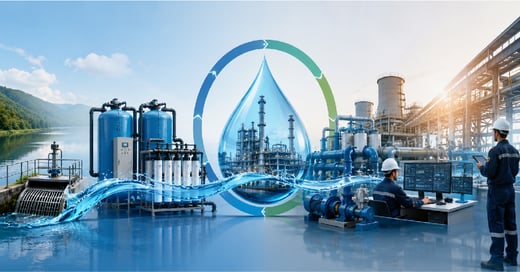
How do you manage the entire water lifecycle as one connected system?
The Hidden Cost of Fragmented Water Strategies
When water systems operate independently, small inefficiencies compound into larger problems:
- Downtime caused by inconsistent water quality
- Higher chemical and energy consumption
- Increased stress on equipment and membranes
- Compliance risks emerging late in the process
- Limited ability to reuse or recover water
According to global industry estimates, inefficiencies across the water lifecycle can inflate operating costs by 20–30%, even when individual systems appear to be performing adequately.
The issue is not technology.
It is a lack of integration.
Why Water Challenges Are Becoming More Complex Globally?
Industrial water management today is shaped by multiple, overlapping pressures:
- Variable source water quality
- Higher production intensity
- Tighter discharge and reuse norms
- Limited space and infrastructure flexibility
- Sustainability and ESG accountability
Managing these challenges through isolated upgrades leads to short-term fixes—but long-term instability.
What global facilities need is visibility, coordination, and control across the full water cycle.
What Total Water Management Really Means?
Total Water Management is not a single product or system.
It is an approach that connects:
Instead of reacting to issues at individual points, Total Water Management focuses on optimising performance end-to-end.
The outcome is not just cleaner water—but more predictable operations.
How Integrated Water Management Changes Outcomes?
When water systems are designed and managed as a whole, facilities gain:
- Improved uptime through stable water quality
- Lower total cost of ownership across treatment stages
- Faster compliance with evolving regulations
- Higher reuse potential without added complexity
- Better resilience to variability and future constraints
Problems are identified earlier.
Decisions are made with system-wide impact in mind.
Resources are used more efficiently.
Why Global Industries Are Shifting Toward Integrated Water Thinking?
Across manufacturing, power, chemicals, pharmaceuticals, and infrastructure, leading operators are moving away from reactive, point-by-point solutions.
They are adopting Total Water Management to:
- Reduce operational surprises
- Align water strategy with business continuity
- Support long-term sustainability targets
- Build flexibility into future expansions
Water is no longer treated as a utility.
It is treated as a strategic asset.
From Treatment to Strategy
Total Water Management represents a mindset shift:
From isolated systems → connected performance
From compliance-driven decisions → resilience-driven strategy
From short-term fixes → long-term value creation
In a world where water challenges are intensifying, this shift is no longer optional.
Conclusion
If fragmented water systems are creating inefficiencies, risks, or limitations across your operations, our experts can help you evaluate how an integrated Total Water Management approach can improve performance, compliance, and sustainability.
Connect with our experts to explore a smarter, end-to-end water strategy.