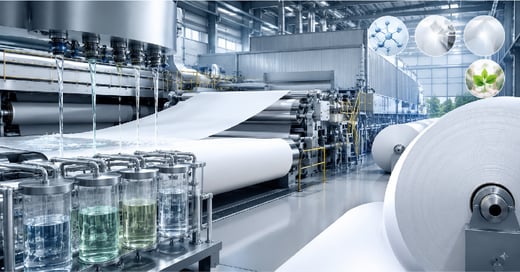
The Indian paper industry is under growing pressure.
Stricter environmental regulations, rising input costs, and increasing demand for consistent product quality are forcing manufacturers to rethink how they treat process water and effluent—especially in high-load streams containing lignin.
While most mills invest in primary and secondary treatment, color removal and clarification remain persistent bottlenecks. Lignin-based coloration not only impacts discharge compliance but also affects reuse, machine cleanliness, and downstream operations.
The result?
Higher chemical consumption, inconsistent water quality, operational inefficiencies, and growing regulatory exposure.
The Bigger Problem: Color Is Treated as a By-Product, Not a Process Variable
In many pulp and paper operations, color removal is still handled as an end-of-pipe correction rather than a controllable process parameter.
Typical challenges include:
- High residual color even after conventional clarification
- Excessive coagulant and flocculant dosing
- Sludge generation that increases disposal costs
- Poor clarity that limits water reuse potential
Color is often addressed after it becomes visible, instead of being managed at the molecular level where lignin actually behaves.
This reactive approach leads to:
- Inconsistent discharge quality
- Rising treatment costs
- Limited reuse of treated water
- Higher risk of non-compliance
The Smaller Gaps Most Solutions Miss
While most treatment programs focus on “removing suspended solids,” they frequently overlook the deeper challenges of lignin-based color:
-
Lignin Is Not Just Particulate
Lignin exists in dissolved and colloidal forms that do not settle easily. Conventional clarification systems struggle to destabilize these fractions effectively.
-
Overdosing to Compensate for Inefficiency
To achieve visible clarity, mills often increase chemical dosages—driving up costs and sludge volumes without guaranteeing consistency.
-
Clarification Without True Color Breaking
Many systems reduce turbidity but fail to chemically break lignin color bodies, resulting in residual tint that still violates reuse or discharge expectations.
Better performance is often assumed to require higher operational expense—creating a false choice between compliance and cost control.
How Ion Exchange Solves Both the Big and the Small?
Ion Exchange approached the problem differently—by targeting lignin color at the molecular interaction level, not just through mechanical separation.
Using BPA Technology powered INDFLOC, Ion Exchange delivered:
✔ Effective lignin color breaking
✔ Superior clarification
✔ Reduced chemical consumption
✔ Lower sludge generation
✔ Improved treated water quality for potential reuse
The result was not just cleaner water—but a process-level transformation in how color is managed within paper mill operations.
This innovation proved to be:
- Technically superior – by addressing dissolved lignin fractions
- Operationally stable – delivering consistent clarity
- Economically efficient – reducing total treatment costs
- Environmentally compliant – supporting stricter discharge norms
Ion Exchange became the first in India to lead this breakthrough, demonstrating that color removal does not have to come at the cost of economics.
Why BPA Technology-Powered INDFLOC Stands Apart?
✔ True Color Breaking – Goes beyond turbidity to chemically destabilize lignin
✔ Process Integration – Fits into existing treatment systems without major retrofits
✔ Cost Efficiency – Lower dosing, reduced sludge handling, improved reuse potential
✔ Regulatory Readiness – Supports compliance with tightening environmental norms
✔ Proven in Real Operations – Backed by field-validated case study performance
This is not just treatment—it is process optimization.
From Treatment Vendor to Process Partner
Ion Exchange does not simply supply chemicals. We work alongside mill operations, EHS teams, and process engineers to redesign how treatment challenges are solved—balancing performance, compliance, and cost in a single strategy.
By applying BPA Technology powered INDFLOC, we help paper manufacturers:
- Reduce treatment variability
- Control color at the source
- Improve water reuse feasibility.
- Lower long-term operating expenses
Clarity Is No Longer a Trade-Off Between Compliance and Cost
Modern paper manufacturing demands more than just “acceptable” treatment. It requires solutions that improve process efficiency while meeting environmental responsibility.
BPA Technology-powered INDFLOC proves that lignin color breaking and economical operation can go hand in hand.
Connect with Ion Exchange experts to evaluate your current color removal challenges and explore how advanced clarification can improve both compliance and profitability. Implement a smarter, more efficient approach to lignin management in your treatment process.