Water has quietly moved from being an operational input to a strategic risk. Across industries, cities, and institutions, the question is no longer how much water do we need, but how sustainably can we manage every drop we touch. Climate volatility, rising demand, tightening regulations, and growing public scrutiny have made one thing clear: fragmented water solutions are no longer enough.
This is where Total Water Management (TWM) becomes not just relevant, but essential.
The Reality Businesses and Cities Are Facing
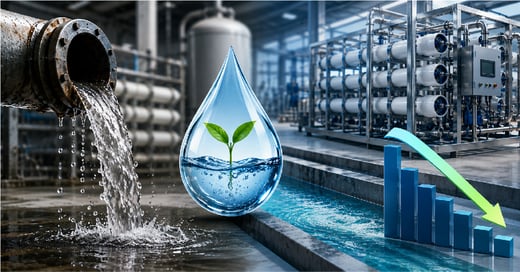
India is among the most water-stressed countries in the world. Industrial water demand is projected to double in the coming decades, while freshwater availability continues to decline. Urbanisation is accelerating wastewater generation faster than infrastructure can keep up. Industries face stricter discharge norms, higher costs of freshwater procurement, and increasing pressure to demonstrate environmental responsibility.
Yet, many water strategies still operate in silos—freshwater intake is planned separately from wastewater treatment, reuse is treated as an afterthought, and monitoring is often reactive rather than predictive. This fragmented approach leads to inefficiencies, higher operating costs, compliance risks, and long-term sustainability challenges.
Growth under these conditions is fragile.
What Total Water Management Really Means?
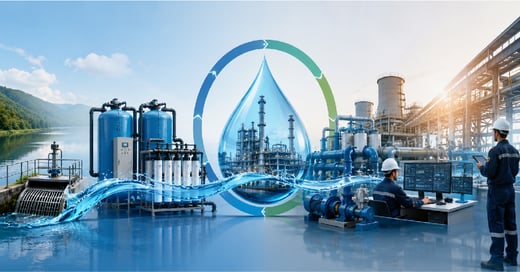
Total Water Management is not a single technology or plant. It is a holistic, lifecycle-based approach that looks at water from source to discharge and reuse, integrating every stage into one cohesive system.
It involves:
- Optimising raw water intake and treatment
- Minimising losses and inefficiencies across processes
- Treating wastewater not as waste, but as a recoverable resource
- Enabling reuse, recycling, and zero liquid discharge where feasible
- Using automation, monitoring, and data to drive continuous improvement
When water is managed as one interconnected system rather than isolated processes, sustainability stops being aspirational and starts becoming operational.
Why Sustainability Without TWM Is Incomplete?
Many organisations invest in individual sustainability initiatives—an efficient RO plant here, a recycling system there. While valuable, these isolated upgrades often fail to deliver long-term impact if they are not aligned with a broader strategy.
True sustainability requires:
- Lower freshwater dependency
- Reduced energy and chemical consumption
- Stable compliance across changing regulations
- Predictable operating costs over time
Total Water Management brings these elements together. It allows organisations to decouple growth from water consumption, ensuring that expansion does not automatically mean higher environmental impact.
The Role of Technology and Integration
Modern water challenges cannot be solved with legacy thinking. Advanced treatment technologies, membranes, resins, biological processes, and digital monitoring systems must work in unison.
Integrated systems enable:
- Higher recovery rates from the same water source
- Consistent output quality across fluctuating influent conditions
- Early identification of inefficiencies or failures
- Optimised chemical dosing and energy usage
The result is not just compliance, but operational resilience.
How Ion Exchange Enables Total Water Management?
For over six decades, Ion Exchange has worked at the intersection of water, engineering, and sustainability. This experience has shaped a deep understanding of one core truth: water challenges are rarely isolated, and solutions shouldn’t be either.
Ion Exchange’s strength lies in its ability to deliver end-to-end water and wastewater solutions—from concept and design to execution, optimisation, and lifecycle support. Whether it is industrial water treatment, municipal infrastructure, advanced membranes, specialty resins, wastewater recycling, or digital monitoring platforms, every solution is designed to fit into a larger, integrated water strategy.
Instead of selling individual components, Ion Exchange focuses on building systems that work together—systems that reduce freshwater intake, maximise reuse, control operating costs, and ensure long-term compliance.
From Cost Centre to Growth Enabler
When water is poorly managed, it becomes a cost centre—unpredictable, risky, and resource-intensive. Under a Total Water Management framework, water becomes a growth enabler.
Organisations benefit from:
- Reduced dependence on scarce freshwater sources
- Lower long-term OPEX through efficient recovery and reuse
- Improved ESG performance and stakeholder confidence
- Greater readiness for future regulations and expansion
This shift is critical for industries such as pharmaceuticals, food and beverages, power, chemicals, infrastructure, and real estate—sectors where water reliability directly impacts business continuity.
Cities, Communities, and the Bigger Picture
Total Water Management is not just an industrial need; it is a societal one. Urban centres are under pressure to provide safe drinking water, treat sewage responsibly, and protect local water bodies—all while managing population growth.
Integrated water solutions help cities move from linear “use and dispose” models to circular water economies. Treated wastewater becomes a reliable secondary resource. Energy-efficient plants reduce environmental footprint. Smart monitoring improves service delivery and transparency.
Sustainable growth, at a national scale, depends on this shift.
The Next Phase of Water Leadership
Sustainability today is measured not by intent, but by outcomes. Regulators, investors, and communities are looking for tangible proof—reduced withdrawals, higher reuse rates, consistent compliance, and long-term resilience.
Total Water Management provides the framework to deliver these outcomes systematically.
The organisations that lead the next decade of growth will be those that treat water not as a utility expense, but as a strategic asset—planned, protected, and optimised at every stage.
Moving Forward
The transition to Total Water Management does not happen overnight. It starts with asking the right questions:
Where does our water come from?
How efficiently are we using it?
What happens after use?
And how can every stage be better connected?
Ion Exchange works alongside organisations at every step of this journey—designing integrated solutions that address today’s challenges while preparing for tomorrow’s realities.
Because sustainable growth is not possible without water security.
And water security is not possible without Total Water Management.
Connect with Ion Exchange experts to explore how an integrated water strategy can future-proof your operations and drive sustainable growth.